If you work in refrigeration or air conditioning, there’s one name you should know better than most. James Harrison didn’t just tinker with cold air – he figured out how to make ice commercially, chilled Australia’s first beer, and very nearly pulled off one of the greatest logistical feats of the 19th century.
He should be a household name. He isn’t. Here’s why that’s a bit of a national disgrace.
A Printer From Scotland With a Chemistry Background
Harrison was born on 17 April 1816 in Bonhill, Dunbartonshire – a small town on the banks of the River Leven in Scotland. His father was a fisherman, but James had bigger ambitions. He studied at Anderson’s University and the Glasgow Mechanics’ Institution, with a focus on chemistry. He then trained as a printing apprentice in Glasgow and worked as a compositor in London before emigrating to Sydney in 1837 to set up a printing press for the English publishing company Tegg & Co.
From Sydney, he moved to Melbourne in 1839 and picked up work with John Pascoe Fawkner as a compositor and later editor on the Port Phillip Patriot. When Fawkner acquired a new press, Harrison saw an opportunity. He offered Fawkner £30 for the old one and headed to Geelong.
The first edition of the Geelong Advertiser appeared in November 1840. By 1842, Harrison owned it outright.
The Accidental Discovery That Changed Everything
It was while running the Advertiser that Harrison stumbled onto something that would shape modern life.
Movable type needed regular cleaning with diethyl ether. Working at the press one day, Harrison noticed that as the ether evaporated off the metal type, it left the letters noticeably cold to the touch. The evaporation was pulling heat out of the metal.
Most people would have filed that away as a curiosity. Harrison, with his chemistry background, started thinking about what it meant.
What if you could control that process? What if you could use it to make cold – deliberately, consistently, at scale?
Building the World’s First Practical Ice-Making Machine
Harrison began experimenting, and in 1851 his first mechanical ice-making machine started operating on the banks of the Barwon River at Rocky Point in Geelong. This was the first time anyone had produced ice mechanically at a meaningful scale.
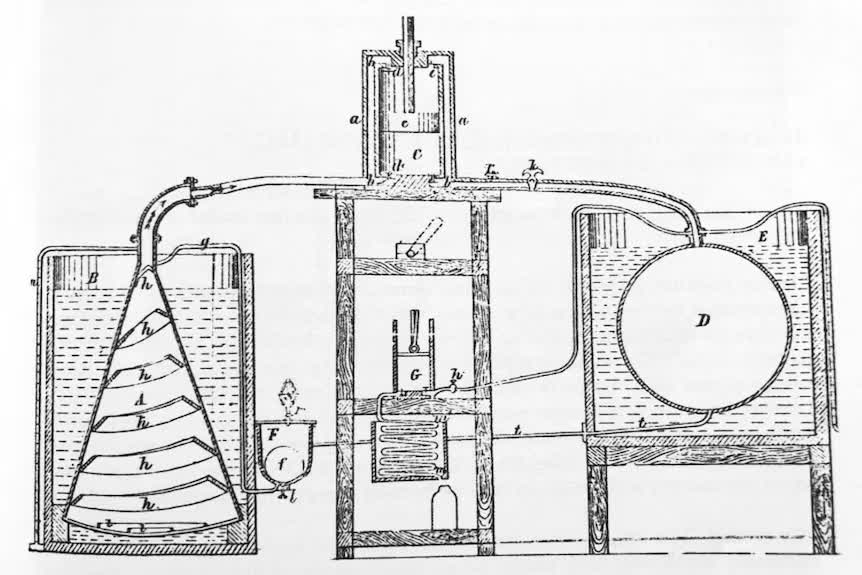
By 1854, he had a commercial machine running. The system worked by using a compressor to force refrigerant gas through a condenser, where it cooled and liquefied. The liquid then circulated through refrigeration coils and vaporised again, drawing heat out of the surrounding environment. The machine used a 5-metre flywheel and could produce around 3,000 kilograms of ice per day.
In December 1855, he was granted an Australian patent for his ether refrigeration system. He then travelled to London and secured British patents in 1856 and 1857, covering both the process and the apparatus.
His timing was good. Importing ice from the United States and Norway was expensive and unreliable for a remote colony like Victoria. A locally-made alternative was immediately attractive.
Beer First, Then Meat
Also in 1856, Harrison was commissioned by a brewery to build a machine that could keep beer cold during fermentation and storage. He delivered. The brewing industry adopted refrigeration almost immediately, and meatpacking factories weren’t far behind.
Think about what that meant in practical terms. In a country as hot as Australia, the ability to reliably chill food and drink wasn’t a luxury – it was a genuine shift in how people lived and ate. Refrigeration changed what could be sold, stored, shipped, and served.
In 1873, Harrison demonstrated the staying power of his process at the Melbourne Exhibition. He showed that meat kept frozen for months remained perfectly edible, and walked away with a gold medal.
The Voyage That Broke Him
By 1873, a new challenge was being debated: could frozen Australian meat be shipped all the way to Britain? American unrefrigerated beef had a stranglehold on the British market. Australian producers needed a way in, and refrigeration looked like the answer.
Harrison decided to be the man who proved it. He prepared the sailing ship Norfolk and loaded it with frozen beef for the voyage to the United Kingdom.
It went badly wrong. His approach relied on a cold room system packed with ice rather than an onboard mechanical refrigeration unit. Partway through the voyage, the ice ran out faster than anticipated. Temperatures rose. The cargo spoiled and had to be discarded.
Harrison arrived in Britain without his meat and without his money. The failure bankrupted him and, perhaps more damaging, shook public confidence in refrigerated meat for years.
Someone Else Got There First
Six years later, in 1879, a separate team succeeded where Harrison had failed. Using a purpose-built refrigerated chamber and a slightly different approach, they delivered frozen Australian meat to Britain. Queen Victoria sat down to a thawed plate of Australian lamb.
Harrison’s name wasn’t part of the celebration.
It’s a rough footnote to an otherwise remarkable career. The man who developed the practical mechanical refrigeration process, built the machines that changed the brewing and meatpacking industries, and proved frozen meat was safe to eat – lost the race by one critical engineering decision on one ship.
What Happened to Harrison
He returned to journalism after the failed voyage, becoming editor of The Age in Melbourne. He went back to Geelong in 1892 and died at his Point Henry home on 3 September 1893, aged 77.
His legacy lives on in a few quiet ways. The James Harrison Bridge spans the Barwon River in Geelong. A plaque at 100 Franklin Street, Melbourne marks the site of the Victorian Ice Works he founded in 1859. The Australian Institute of Refrigeration Air Conditioning and Heating’s most distinguished award is the James Harrison Medal. And the James Harrison Museum committee has acquired land at Rocky Point – the site of his original machine – with plans to build a museum there.
Why He Matters to the Industry Today
Harrison’s work sits at the foundation of everything the refrigeration and air conditioning industry is built on. The vapour-compression cycle he pioneered in the 1850s is still the basis of how modern refrigeration systems work. The principles haven’t changed. The technology has just gotten smaller, smarter, and significantly more efficient.
Every cool room, every chilled display cabinet, every split-system air conditioner running in homes and businesses across Australia traces a direct line back to a Scottish printer cleaning type with ether in a Geelong newspaper office.
Not bad for a bloke who started out setting type for a London publisher.
James Harrison (17 April 1816 – 3 September 1893) is recognised as a pioneer of mechanical refrigeration and the founder of the Victorian Ice Works. The Australian Institute of Refrigeration Air Conditioning and Heating’s James Harrison Medal honours his contribution to the industry.